Stone care guide
How to remove etch marks from a marble floor or worktop
By King of Stone · · 6 min read
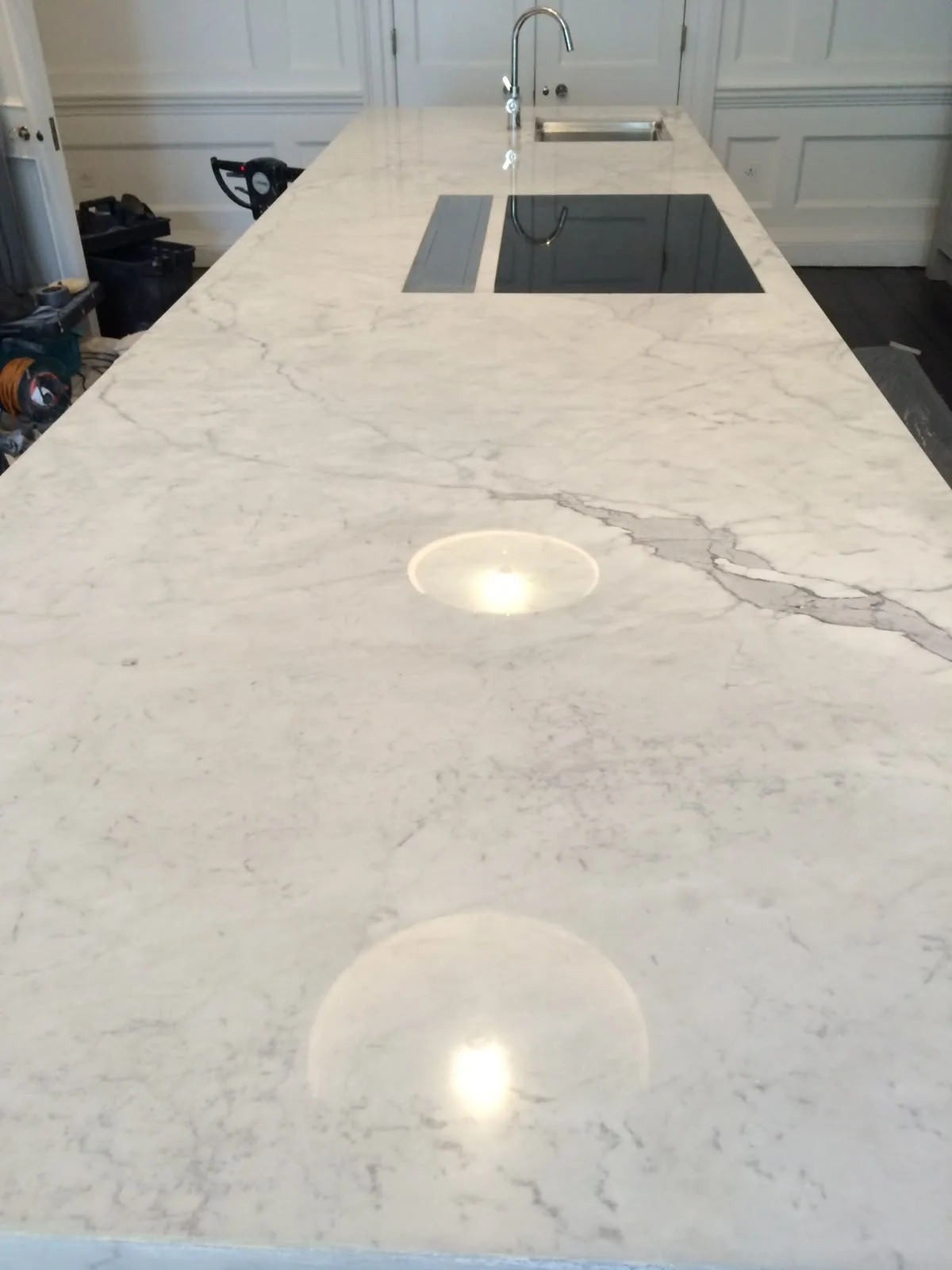
Short answer: etch marks are not dirt — they are tiny areas where acid has dissolved the surface of the marble. Very light etching on polished marble can sometimes be improved at home with a marble polishing powder, but most etch marks, and any etching on a large area, need the surface to be honed and re-polished with diamond abrasives. Sealer does not prevent etching.
What is etching?
Marble is made mostly of calcite (calcium carbonate). Calcite reacts with acids, so when something acidic sits on marble — lemon juice, vinegar, wine, fizzy drinks, tomato sauce, some cleaning sprays, limescale removers or even certain shampoos and cosmetics — it dissolves a microscopic layer of the stone. That leaves a dull, slightly rough mark that looks like a water ring or a cloudy patch. On polished marble it shows clearly because the mark no longer reflects light; on honed marble it is subtler but can still be seen at an angle.
Limestone and travertine are also calcium-based and etch in the same way. Granite and quartzite generally do not, which is why worktop advice for granite does not apply to marble.
Etch or stain? How to tell the difference
This matters, because the fix is completely different.
- An etch is lighter or duller than the surrounding stone. It changes the texture and shine, not the colour. Run a fingertip over it: deeper etching can feel slightly rough.
- A stain is darker (or a different colour). Oil, coffee, tea, wine pigments or rust have soaked into the stone. The surface shine is often unaffected.
Some accidents cause both. Red wine can etch the surface and leave a pigment stain underneath. In that case the stain usually needs a poultice to draw it out first, and the etch is then honed and polished.
What you can try at home
If the marble is polished and the etch is very light — you can see it in reflected light but cannot feel it — a marble polishing powder made for the purpose may reduce it. Follow the product instructions carefully, work a small area with a damp cloth or a soft pad, and rinse thoroughly. Test in an inconspicuous spot first.
What you should avoid:
- Abrasive household creams and scouring pads, which scratch the surface and leave a hazy patch larger than the original etch.
- Waxes, “shine restorers” and topical coatings. They can hide etching for a while, but they wear unevenly, collect dirt and often yellow; they then have to be stripped before the marble can be properly restored.
- Sandpaper. It is very easy to create a dip or a ring of uneven finish that is harder to correct than the etch itself.
- More acid. Vinegar and lemon “natural cleaners” are a common cause of etching in the first place.
On honed marble, home polishing powders usually make things worse, because they create a shiny patch on a matt surface.
When etching needs professional honing and polishing
Call a stone specialist when the etch marks can be felt with a fingertip, when there are many marks across a floor or worktop, when they sit in a traffic lane, or when a home attempt has left the area patchy. Restoration works like this:
- Assessment and test area. We identify the marble, check for old coatings and agree the finish you want — honed, satin or polished.
- Honing. Diamond pads, used wet, remove the damaged surface layer. Deeper etching may need a coarser grit first. Honing is done across the whole area or tile, not only on the mark, so the finish stays even.
- Polishing. Progressively finer diamonds and, where appropriate, polishing powders bring the surface back up to the agreed sheen. The shine comes from the stone, not a coating.
- Sealing and care advice. An impregnating sealer reduces staining. It will not stop future etching, so we explain how to look after the surface.
On a kitchen worktop, an etched area can usually be restored in place without removing the top. Nearby units, the sink and appliances are protected, and the process is wet, so dust is minimal.
How to prevent new etch marks
- Wipe up acidic spills straight away; do not leave them to dry.
- Use coasters, trays and chopping boards on marble worktops.
- Clean with a pH-neutral stone cleaner. Avoid limescale removers, bleach-based sprays and multi-surface cleaners on marble.
- In bathrooms, keep shampoos, perfumes and cosmetics on a tray rather than directly on the stone.
- For high-risk surfaces such as kitchen islands, ask about a clear protective film. It is a practical option if you want polished marble but cook a lot with citrus and wine.
- Accept a little patina. Many owners choose a honed finish in kitchens precisely because light etching is far less visible on it.
How is etch removal priced?
We do not publish a fixed price list, because the work depends on the stone, how deep the etching is, the finish you want and the area involved. What we can say is how pricing works: projects under 100 m² — which includes most worktops, bathrooms, hallways and kitchens — are priced per job as a fixed quote; projects over 100 m² are priced per m². Send a few photos, including one taken at an angle so the etch marks catch the light, and we will reply with honest advice.
Read more about our marble restoration service, or about stone repairs for chips and cracks.
Frequently asked questions
Can etch marks on marble be removed permanently?
The existing etch can be removed completely by honing and re-polishing the surface. Marble will always react to acid, though, so new etching can appear if acidic spills are left on it.
Will sealing my marble stop it from etching?
No. Impregnating sealers reduce staining from oil and water, but acids still react with the calcite in marble. A protective film is the only practical barrier for high-risk worktops.
Can I polish out etch marks myself?
Very light etching on polished marble can sometimes be reduced with a dedicated marble polishing powder. Etching you can feel, or etching on honed marble, needs professional honing so the finish stays even.
Do worktops have to be removed to fix etching?
No. Etched marble worktops are honed and polished in place, with the sink, units and appliances protected.
How is marble etch removal priced?
Projects under 100 m² are priced per job with a fixed quote; projects over 100 m² are priced per m². Photos help us give you a fast indicative price.